Secrets of Black Holes

Declan Kennedy
| 06-05-2026
 · Science Team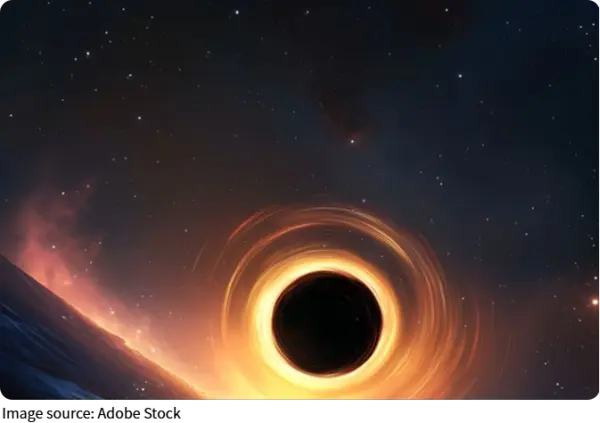
When you think of black holes, the first image that comes to mind might be a dark abyss pulling in everything nearby.
Yet black holes are more than cosmic vacuum cleaners—they are extreme laboratories of physics, warping space and time in ways that challenge our understanding. Observing and studying them helps us glimpse the universe at its most intense.
What Defines a Black Hole
At its core, a black hole is an object with gravity so strong that nothing, not even light, can escape from it. This extreme density arises when a massive star collapses under its own gravity after exhausting its nuclear fuel.
1. Event Horizon
The event horizon marks the boundary around a black hole. Anything crossing this threshold cannot return. For instance, the supermassive black hole in the galaxy M87, imaged by the Event Horizon Telescope, clearly shows this dark circular boundary against the glowing surrounding gas.
2. Singularity
At the center lies the singularity, a point where density becomes theoretically infinite, and conventional physics breaks down. While we cannot observe it directly, its existence is inferred through gravitational effects on nearby matter.
3. Types of Black Holes
Black holes come in various sizes: stellar-mass black holes formed from single stars, intermediate ones with a few hundred times the Sun's mass, and supermassive giants that reside in galaxy centers. Observing X-ray binaries, where a black hole pulls matter from a companion star, provides a practical method to identify stellar-mass black holes.
How Black Holes Affect Their Surroundings
Despite their invisibility, black holes have a profound influence on nearby space, affecting stars, gas, and even entire galaxies.
1. Gravitational Pull
The immense gravity can bend the path of light and distort space, producing phenomena known as gravitational lensing. An example is the Einstein Cross, where light from a distant quasar appears as multiple images around a massive foreground galaxy, showing the warping effect.
2. Accretion Disks
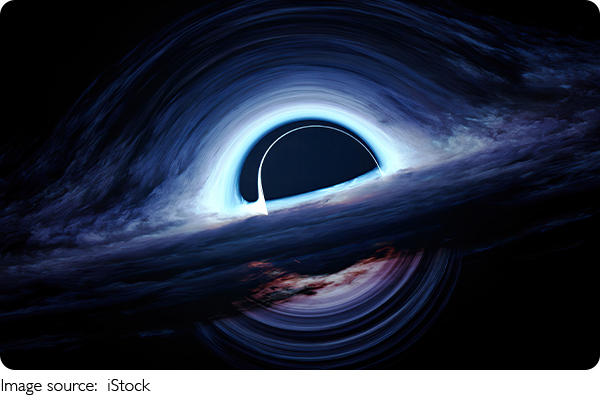
Matter spiraling toward a black hole forms a hot, luminous accretion disk. This disk emits X-rays, which astronomers can detect. Observing accretion disks around black holes in binary systems allows researchers to measure mass and spin.
3. Relativistic Jets
Some black holes launch jets of high-energy particles at nearly the speed of light, extending thousands of light-years into space. The black hole in galaxy Centaurus A provides a striking visual example, with its jet visible across multiple wavelengths.
Black Holes and Time
One of the most fascinating aspects is how black holes warp time. According to Einstein's general relativity, the stronger the gravity, the slower time passes.
1. Time Dilation Near Black Holes
A clock near a black hole ticks more slowly compared to one far away. In practical terms, astronauts near a massive black hole would experience years passing while decades go by elsewhere.
2. Implications for Space Travel
This effect is not just theoretical. Scientists model time dilation scenarios to understand extreme gravitational environments. For example, simulations help predict how signals from spacecraft near strong gravitational fields would behave.
3. Testing Relativity
Observations of stars orbiting the supermassive black hole at our galaxy's center, Sagittarius A*, confirm predictions of general relativity with remarkable accuracy, proving that these regions are perfect natural laboratories.
Observing Black Holes Safely
While we cannot approach a black hole, astronomers employ innovative methods to study them from a distance.
1. Multi-Wavelength Astronomy
Using optical, X-ray, and radio telescopes, scientists detect the influence of black holes on nearby matter. For instance, X-ray emissions from accretion disks reveal the presence of otherwise invisible black holes.
2. Gravitational Waves
Collisions between black holes produce ripples in space-time called gravitational waves. LIGO and Virgo observatories have detected dozens of such events, opening a new window to study black hole mergers.
3. Citizen Science Opportunities
Amateurs can contribute by monitoring variable stars or galaxies for unusual activity, which may indicate interactions with hidden black holes. Participating in projects like Galaxy Zoo allows you to explore real data while learning about cosmic phenomena.
Black holes are more than cosmic enigmas; they are key to understanding the universe's most extreme physics. From bending time to launching jets of particles across galaxies, they reshape space in ways that challenge our imagination. Next time you gaze at the night sky, remember that somewhere out there, these silent giants are shaping the cosmos, holding secrets that scientists continue to unravel.