Red Lechwe Revealed!

Malcolm
| 28-10-2026
 · Animal Team
Across the wetlands of southern Africa, the red lechwe moves through shallow water and muddy grasslands with remarkable ease. This antelope has a distinctive appearance and a lifestyle closely connected to seasonal floods.
While many grazing animals prefer firmer ground, the red lechwe makes use of marshes and flooded plains, where its body shape, hooves, and feeding habits help it thrive.
Where Red Lechwe Live
The red lechwe is a form of lechwe, an antelope belonging to the genus Kobus, which also includes species such as the waterbuck, kob, and puku. Red lechwe are associated with wetland systems in southern Africa, particularly the Okavango and Linyanti regions and areas around the upper Zambezi. Other lechwe populations occur across parts of central and southern Africa.
Their preferred habitat includes seasonal floodplains, marshes, and grassy areas bordering lagoons and waterways. These environments change throughout the year as water levels rise and fall. Fresh vegetation grows along flooded edges, providing valuable feeding grounds.
Because red lechwe rely so heavily on wetlands, the condition of these habitats has a direct effect on their future. The species is classified as Near Threatened on the IUCN Red List, making the preservation of healthy floodplains especially important.
Recognising Their Appearance
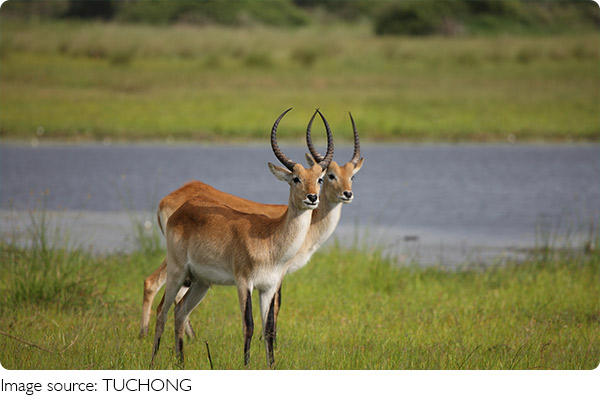
Red lechwe have a reddish-brown coat across much of the upper body, contrasting with lighter colouring underneath. Their lower legs have distinctive dark markings on the front, while pale patches around the eyes add another identifying feature. They are medium-to-large antelope, with males generally larger and heavier than females. Their build is well suited to moving across open grasslands and wet terrain, although their proportions differ from those of many other grazing species.
Horns are found on males, not females. These long, curved structures rise in a lyre-like shape, with a sweeping outline that makes them easy to recognise. In a herd containing both sexes, horn shape is a useful clue for identifying males from a distance.
Hooves Made for Wet Ground
One of the red lechwe's most useful features is its hoof structure. The hooves are adapted for soft, damp ground, helping the animal move across muddy surfaces that may be difficult for species more accustomed to dry plains. Their long legs also contribute to their unusual movement. The hindquarters sit higher than the front of the body, giving the animal a sloping outline. When travelling across shallow water or marshy grassland, red lechwe often move with energetic bounds rather than a steady, even trot.
Their legs have a water-repellent coating that helps reduce the effects of moving through wet surroundings. Together, these characteristics support their ability to travel and feed in places where the ground is soft and uneven.
Feeding Among the Floods
Red lechwe mainly graze on grasses and other plants associated with wet habitats, including sedges. Seasonal flooding encourages fresh plant growth around channels, lagoons, and low-lying grasslands, giving the antelope access to a useful food supply. They can feed while standing in water, sometimes entering areas that are too deep or inconvenient for many other grazing animals. This gives them access to vegetation along flooded edges and within shallow wetlands.
Their feeding patterns naturally follow changes in the landscape. When water spreads across the floodplain, new areas become accessible. As levels recede, different patches of grassland may offer feeding opportunities.
Herds and Daily Activity
Red lechwe are social animals and often gather in groups. Herd composition can vary with the season and breeding activity, with groups of males or females commonly seen outside the mating period. Where food and habitat conditions are favourable, large gatherings may form across open floodplains.
The cooler parts of the day are often the best times to observe their activity. Red lechwe tend to feed and move more during the morning and late afternoon, while resting more during the heat of midday.
Wetlands as Shelter
Shallow water can provide red lechwe with an advantage when they need to move away from danger. Their ability to travel through flooded ground may make pursuit more difficult for some land-based predators. However, wetlands are not entirely safe, and aquatic predators can pose their own risks.
The red lechwe is a striking example of how wildlife can adapt to a specialised environment. Its distinctive coat, curved horns in males, wet-ground mobility, and grazing habits all reflect a close relationship with floodplains. For anyone observing red lechwe in their natural surroundings, their graceful movement through shallow water offers a clear glimpse of how life and landscape are connected.